
ECB’s Wunsch Predicts Healthy Rebound But Bumpy Crisis Exit

Parts of the EU have tightened business and social restrictions to combat infections.
Photographer: Liesa Johannssen-Koppitz/Bloomberg
Photographer: Liesa Johannssen-Koppitz/Bloomberg
Explore what’s moving the global economy in the new season of the Stephanomics podcast. Subscribe via Apple Podcast, Spotify or Pocket Cast.
The euro-area economy is headed for a healthy rebound once coronavirus restrictions come to an end, but investors still need to brace for a bumpy exit from unprecedented stimulus, European Central Bank Governing Council member Pierre Wunsch said.

Photographer: Lauri Dieffembacq/Belga Mag/AFP/Getty Images
“A lot of the conditions are met for a sustained recovery when we get out of lockdown, and if it’s not enough then we’ll have to do more,” Wunsch said in an interview on Tuesday. “I hope that at some point we’re going to discuss an exit, because it will show that our policy is effective. But exit is never a piece of cake.”
Officials globally are considering the risk associated with the transition back to normality as crisis support is unwound. Central bankers in particular are acutely aware of the so-called taper tantrum of 2013 when the U.S. Federal Reserve’s plans to phase out its bond purchases caused yields to spike.
The ECB is already battling upward pressure on yields from the U.S. recovery and its $1.9 trillion fiscal stimulus, which threaten to push up euro-area borrowing costs too soon. The Governing Council recently accelerated asset purchases under its 1.85 trillion-euro ($2.2 trillion) pandemic program, which is scheduled to last until the end of March 2022.
“These inflection points need to be handled with care, we’ve seen that with the taper tantrum,” Wunsch said. “I can’t promise that when we can start discussing an exit — and I hope we can within a reasonable time frame — that it’s going to be completely smooth.”
ECB’s Crisis Response
The central bank’s main tools to fight the virus fallout
Source: ECB
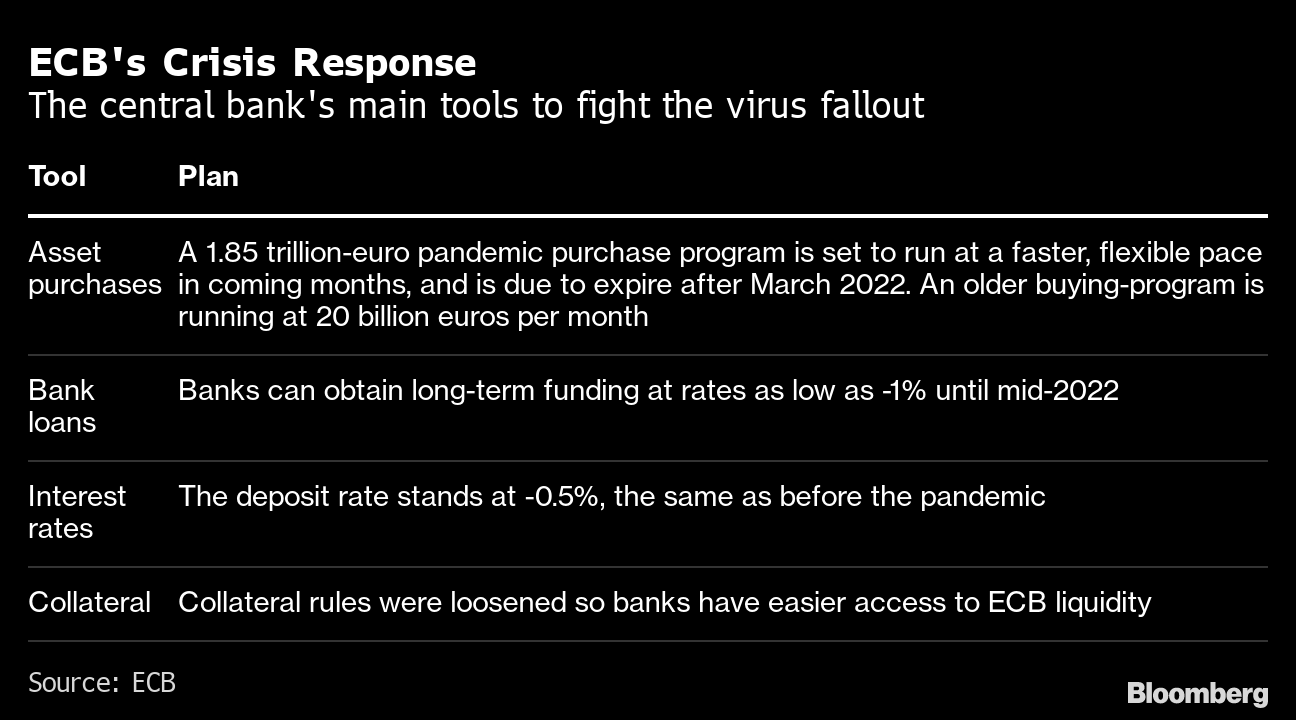
The euro zone’s exit looks likely to come later than in other parts of the industrialized world. The European Union’s relative slowness on vaccinations has forced parts of the bloc including Belgium, where Wunsch heads the central bank, to tighten business and social restrictions to combat a third wave of infections.
International Monetary Fund forecasts published Tuesday highlighted how the U.S. economy is powering ahead of the euro zone. The IMF also warned that governments should scale back fiscal aid gradually, and that central bankers should give clear guidance on monetary policy to minimize the danger of disruptive capital flows.
Diverging Growth
The IMF predicts the euro area will expand 4.4% this year
Source: IMF

Read more: IMF Boosts Global Growth Forecast, Warns of Diverging Rebound
Wunsch said there’s “room to take some bad news” before the ECB would need to lower its latest economic projections, which foresee 4% growth this year. Still, he acknowledged that excessive delay in the upturn could force officials to extend their monetary support.
“If there would be at some point structural damage because of a lockdown lasting much longer in Europe than in other areas, then I guess at some point we could decide to go beyond March,” Wunsch said. “But conversely, if the news would be systematically good, at some point it will go with some tightening of nominal rates and that’s something that’s even desirable.”
He also addressed concerns that the EU is moving too slowly with its 750 billion-euro joint recovery fund, saying the combination of national and combined measures has been “appropriate.”
Fiscal support is “much more focused than in the U.S. We’ve taken timely, temporary and targeted measures,” Wunsch said. “We have automatic stabilizers in Europe that they don’t have in the U.S. So in a way our fiscal response was more efficient.”
— With assistance by Zoe Schneeweiss
(Updates with additional comments from fifth paragraph.)
