
Want Cleaner, Healthier Salmon? Raise Them on Land
In a small town near the coast of Nova Scotia, Canada, 200,000 Atlantic salmon—lean, firm, their persimmon-colored flesh endorsed by a famed Canadian chef for quality and taste—are being carefully tended for next year’s harvest. Some 2,000 miles south in a suburb of Miami, 2.5 million fish—10,000 metric tons—are being raised in saltwater pens for the same purpose. Nova Scotia’s Sustainable Blue and Florida’s Atlantic Sapphire ASA differ widely in scale but share a common ambition. Both are on the verge of doing something long considered almost impossible: turning a profit raising a premium Atlantic salmon that’s never touched the sea.
Expensive, technically difficult, and plagued with its own environmental challenges, salmon farming on land has so far been a niche industry producing a relatively expensive product. But its proponents say it offers the best shot over the long term at making a core food source if not fully sustainable, at least much more so than traditional marine-based farming.
Sourcing the World’s Fish
Global capture fisheries and aquaculture production, in metric tons
Excludes aquatic mammals; crocodiles, alligators, and caimans; and seaweeds and other aquatic plants.
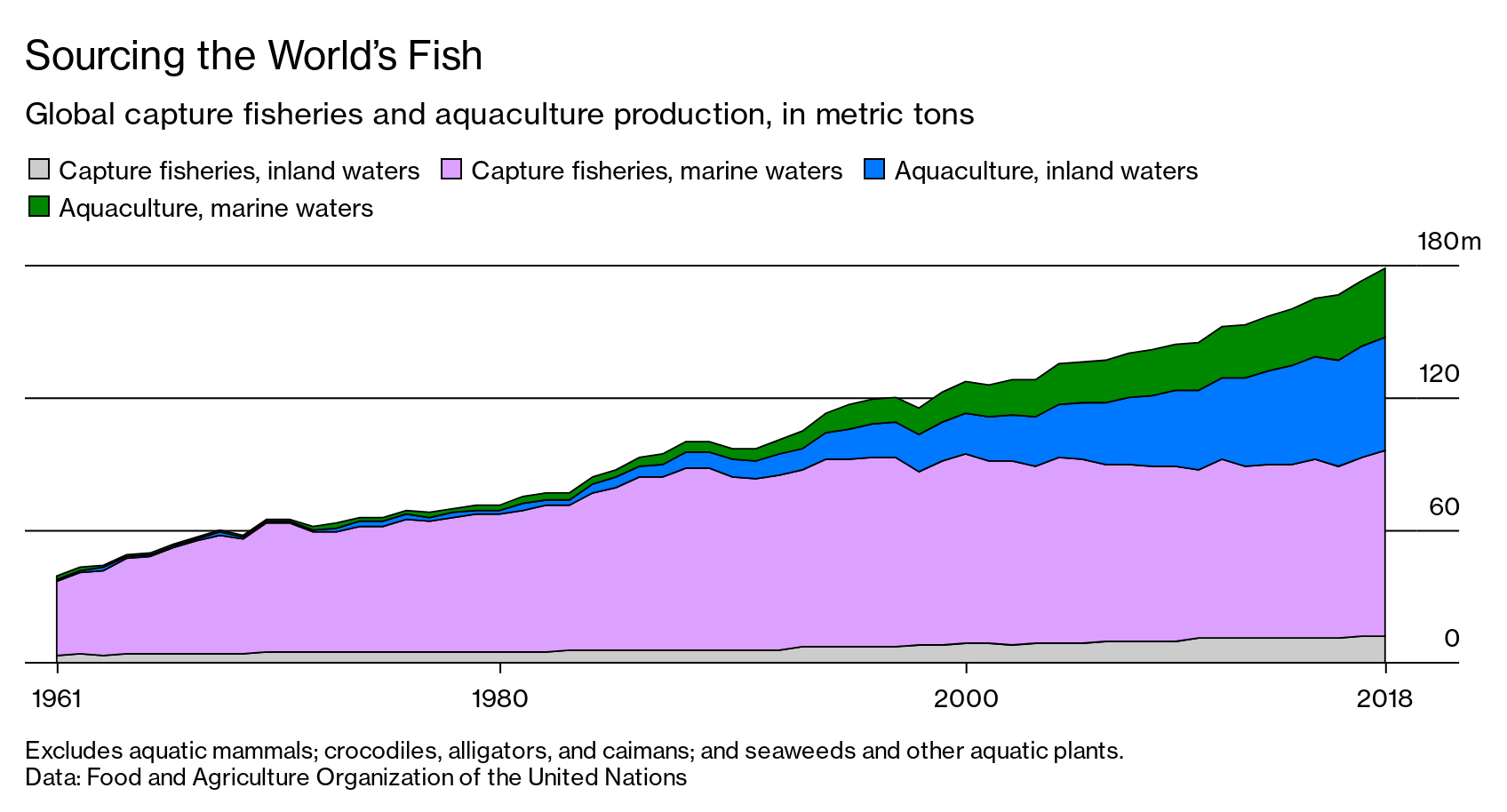
Human per capita fish consumption has more than doubled over the past six decades, to 20.3 kilograms (44.8 pounds) in 2017, propelled by changing dietary preferences and population growth, according to the United Nation’s Food and Agriculture Organization, even as the planet’s supply of wild fish is falling. About 87% of the 179 million metric tons (197 million tons) of fish produced through wild capture and farming in 2018 ended up on our plates, and that share is growing, according to the organization. Aquaculture, or seafood farming, now supplies the majority of the fish we eat, and salmonids—an illustrious family whose members include trout and char—account for almost a fifth of that market, but at a steep environmental cost.
It’s one thing to farm sustainable bivalve mollusks, which consume plankton through their gills while filtering their habitat water. It’s quite another to manage hundreds of thousands of carnivorous salmon caged in open-net pens suspended in the ocean, the typical salmon aquaculture operation. The worst problems created by such farms are analogous to those of piggeries and battery chicken cages: high rates of death and disease, threats to wild native species, algae blooms, and feces, so much feces. “You have under the cage, one meter—three feet or more—composed of fecal matter and rotting food, and that is the most disgusting thing you can imagine,” says Daniel Pauly, professor of fisheries at the University of British Columbia. “And sometimes that stuff, in a storm, gets stirred up and kills all the fish.”
Much of the world’s farmed salmon is flown to customers to keep it fresh, resulting in hefty transport emissions. And it doesn’t even put a dent in global food insecurity. That’s because the feed required to ensure farmed salmon contains the same heart-healing omega-3 fatty acids as their wild cousins is made with smaller oily fish such as anchovies and sardines, which people also eat. Land-based farms are studying if they can feed the salmon insects, instead.
A chameleon that changes from speckled or silvery blue and brown to crimson and orange with green heads or stripes, a wild salmon enjoys a rather epic life cycle. After hatching in fresh water, the juvenile fish make their way to the ocean, where they reach maturity, before battling their way back upstream to spawn at their birthplace, heroic journeys of hundreds or even thousands of miles, marked by acrobatic leaps along the way. Land-based fish farms try to mimic that process in fresh and saltwater tanks while minimizing interaction with local ecosystems to avoid the worst contagions caused by open-net-pen farms.
The complexity of keeping large numbers of salmon healthy in recirculated water has, until now, limited the land-based sector’s ability to grow. Sustainable Blue’s technology, developed over 20 years, discharges no water into the environment, keeps salmon in salt water longer for taste, and converts solid waste to biofuel. The smallest miscalculation—letting carbon dioxide levels build up too much, over-stressing the filtration system, introducing bacteria into the water that changes the flavor profile, or even a minor power hiccup—can be disastrous.
For Sustainable Blue and other land-based salmon farms, the biggest sustainability challenge is ensuring the energy used to filter and recirculate huge amounts of water is renewable, or clean. With Nova Scotia beginning to draw renewable hydroelectric power from neighboring Labrador, management is optimistic the facility’s carbon footprint can be significantly reduced. It’s producing a salmon that poses no threat to wild fish and ecosystems, requires no growth hormones or antibiotics, and is free of viruses and sea lice, says Kirk Havercroft, chief executive officer.
Sustainable Blue’s salmon fillets sell for C$18 to C$20 ($14.80 to $16.50) per pound, compared with about C$13 a pound for ocean-farmed Atlantic salmon. That gap is expected to narrow as the operation scales up production to 1,000 tons next year, from previous harvests of 100 to 150 tons, Havercroft says.
The company expects to cross into profitability in 2022, plans to expand to 5,000 tons a year, and is in active talks to potentially license its technology to other producers, he says.
There are fewer than 100 land-based salmon projects in the works globally, some attracting significant interest from private equity and investment banks. Backers say the potential for growth is enormous, with marine-based salmon farms under mounting pressure to clean up or close down. The Canadian government is phasing out open-net-pen farms in British Columbia, despite industry pushback. Pauly, the fisheries professor, says the land-based sector is a sustainable, specialized option—especially if insect feed is used—but is skeptical it can be done at scale.
A major ecological benefit of land-based salmon farming is that it removes the fish from natural marine habitats, eliminating the risk that they pass on a host of viruses and parasites. Recently published research by Gideon Mordecai, a viral ecologist at the University of British Columbia, shows that open-net-pen Atlantic salmon are continually infecting British Columbia’s wild Chinook salmon with Piscine orthoreovirus, associated with kidney and liver damage in wild fish. Because the virus can survive weeks in the water, it can spread with tidal movements as well as with escaped Atlantic salmon, infecting a range of fish species including herring, Mordecai says.
When Donald Wesley, a hereditary chief of the Gitwilgyoots tribe, began his fishing career 45 years ago, the icy waters around Port Simpson, B.C., teemed with wild sockeye salmon. “These big rivers that we had were the most bountiful rivers in all the world in my time, and now they’re gone to the point of extinction,” he says. “Even the herring is gone. And the herring is the fish that keeps the whole ecosystem alive.” About 15 years ago, a major open-net-pen salmon producer tried to start a farm nearby, but the community sent its executives packing, Wesley says. He’s skeptical about land-based farming, too, doubting large conglomerates will ever spend the money when the alternative is so much cheaper. For him, the only solution is to restore the wild population so it can be fished responsibly.
Atlantic Sapphire says it has the financing to do large-scale sustainable salmon farming on land. And its Florida project may be the industry’s best test. “As long as we don’t have a negative environmental footprint, then we are free to grow as much as we can,” says Chief Financial Officer Karl Oystein Oyehaug. The company has facilities in Denmark and the U.S. that are already the largest of their kind. The bigger Florida site is expected to produce 10,000 tons of Atlantic salmon next year, pushing the company to its first full-year profit, and by 2031 it’s aiming for 220,000 tons—far more than most open-net farms.
Atlantic Sapphire benefits from the state’s geology, drawing contaminant-free salt water from an ancient aquifer. Less than 1% of the project’s water is discharged as nontoxic wastewater into a boulder zone 3,000 feet down, the same way Miami gets rid of human wastewater. Over thousands of years, the water is filtered through the rock and eventually flows back to the ocean completely clean, Oystein Oyehaug says. “We’re producing salmon in tropical Florida, a cold-water species, with absolutely zero impact on the ocean,” he says.
Processed on site and shipped to customers by road, the fish can be on a Floridian’s plate within 24 hours, selling for a 50% premium to farmed ocean salmon, at about $15 per pound. Atlantic Sapphire is working on using 100% renewable energy, including solar, and looking to remove fish from its feed by 2025.
Some critics question all the hoops being jumped through in the name of serving sustainable pink fish. “So carnivorous salmon should be domesticated and fed a plant-based diet in service of omnivorous humans?” says Jennifer Jacquet, an associate professor in the Department of Environmental Studies at New York University. Mordecai says he recently discovered a company that makes artificial smoked salmon using carrots. “I actually tried it when I was out in a restaurant, and it was pretty good.”
BOTTOM LINE –
The world needs more fish, but conventional salmon aquaculture is harmful. Raising them on land may soon be a viable option.
