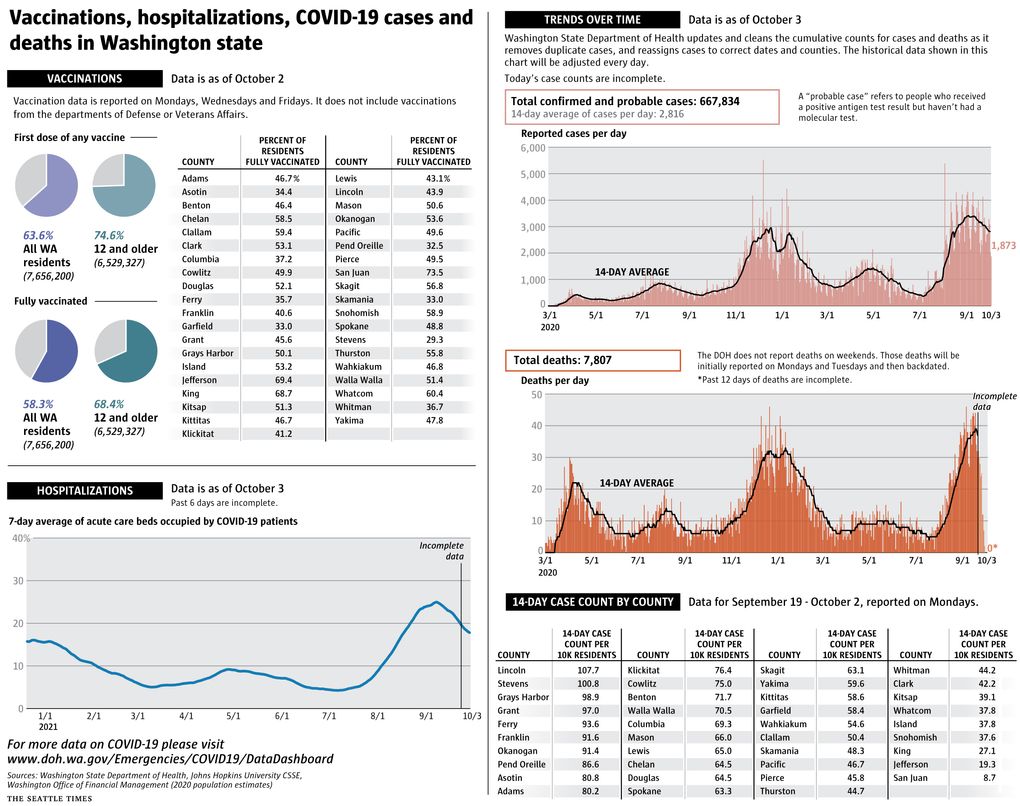
Washington health officials on Monday urged state residents to stay as healthy as possible as the deadline for state workers to receive the COVID-19 vaccine approaches in a couple of weeks. Officials cited worries that the inability of unvaccinated health employees to work may place additional strains on hospitals already struggling with staffing.
Meanwhile, federal authorities charged a Michigan nurse with stealing coronavirus vaccination cards from the hospital where she worked and selling them to unvaccinated individuals at $150-$200 during a period of over four months.
In a move following Pfizer and Moderna, Johnson & Johnson on Tuesday asked the Food and Drug Administration to authorize a booster shot as evidence continues to highlight that elderly and high-risk groups may need additional safeguards against the virus.
We’re updating this page with the latest news about the COVID-19 pandemic and its effects on the Seattle area, the U.S. and the world. Click here to see previous days’ live updates and all our other coronavirus coverage, and here to see how we track the daily spread across Washington and the world.
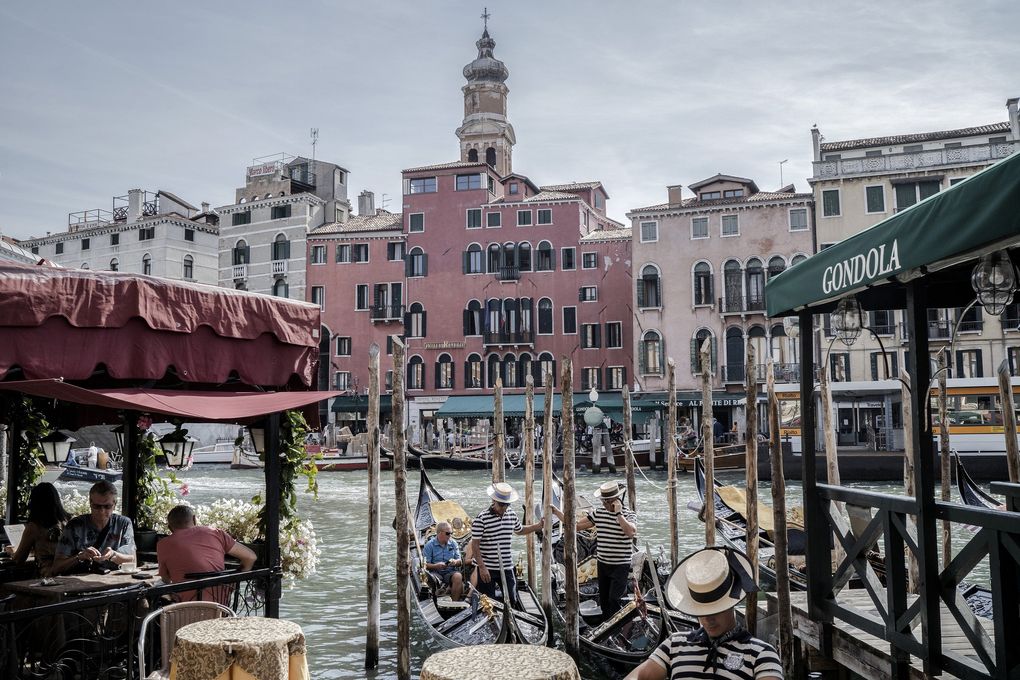
Venice, overwhelmed by tourists, tries tracking them
As the pandemic chased away visitors, some Venetians allowed themselves to dream of a different city — one that belonged as much to them as to the tourists who crowd them out of their stone piazzas, cobblestone alleyways and even their apartments.
In a quieted city, the chiming of its 100 bell towers, the lapping of canal waters and the Venetian dialect suddenly became the dominant soundtrack. The cruise ships that disgorged thousands of day-trippers and caused damaging waves in the sinking city were gone, and then banned.
But now, the city’s mayor is taking crowd control to a new level, pushing high-tech solutions that alarm even many of those who have long campaigned for a Venice for Venetians.
The city’s leaders are acquiring the cellphone data of unwitting tourists and using hundreds of surveillance cameras to monitor visitors and prevent crowding. Next summer, they plan to install long-debated gates at key entry points; visitors coming only for the day will have to book ahead and pay a fee to enter. If too many people want to come, some will be turned away.
The conservative and business-friendly mayor, Luigi Brugnaro, and his allies say their aim is to create a more livable city for beleaguered Venetians.
“Either we are pragmatic, or we live in the world of fairy tales,” said Paolo Bettio, who heads Venis, the company that handles the city’s information technology.
Read the story here.
—Emma Bubola, The New York Times
Virus deaths in Russia hit record for third time this month
Coronavirus deaths in Russia hit a record for the third time this month on Tuesday, and daily new infections once again exceeded 25,000 — a surge that comes as vaccination rates in the country remain stagnantly low and the government shuns imposing tough restrictions to stem the spread.
Russia’s state coronavirus task force reported 25,110 new confirmed cases on Tuesday and 895 new deaths — the country’s highest daily death toll in the pandemic. The previous record, of 890 deaths, was registered on Sunday, and the one before that, of 887 deaths, occurred on Friday.
The Kremlin has said that the situation elicits concern, but still it is not considering a countrywide lockdown or any other nationwide measures.
Read the story here.
—The Associated Press
AstraZeneca asks FDA to authorize COVID antibody treatment
AstraZeneca, the drugmaker that developed one of the first COVID-19 vaccines, has asked the U.S. Food and Drug Administration to authorize the emergency use of a first-of-a-kind antibody treatment to prevent the disease.
The Anglo-Swedish company said Tuesday that the treatment, known as AZD7442, would be the first long-acting antibody combination to receive an emergency authorization for COVID-19 prevention. If authorized, the drug would likely be limited to people with compromised immune systems who don’t get sufficient protection from vaccination.
The FDA has authorized three other antibody drugs already, including two that can be given after a possible COVID-19 exposure to head off symptoms. AstraZeneca’s drug would instead be given as a preventive measure in people who have increased vulnerability to the virus.
The FDA has stressed that antibody drugs are not a substitute for vaccination, which is the most effective, long-lasting form of virus protection. Antibody drugs also are expensive to produce and require an IV or injection and health care workers to administer.
Read the story here.
—The Associated Press
WHO still reviewing Sputnik V vaccine, as Russia presses bid
The World Health Organization is still reviewing data about Russia’s Sputnik V vaccine as part of hopes that it can be approved by the U.N. health agency for emergency use against coronavirus, but said Tuesday that no decision is imminent.
The clarification comes after Russian Health Minister Mikhail Murashko in recent days said that administrative issues were among the main holdups in WHO’s decision-making process about whether to grant an emergency use listing to Sputnik V, as it has for a half-dozen other vaccines.
Such approval would be a show of international confidence in the vaccine after a rigorous review process, and could pave the way for its inclusion into the COVAX program organized by WHO and key partners that is shipping COVID-19 vaccines to scores of countries around the world based on need.
Read the story here.
—The Associated Press
Catch up on the past 24 hours
Will Washington’s highest-paid employee lose his job? There’s no reason to believe WSU football coach Nick Rolovich got a vaccine in time to comply with the state’s mandate. That leaves one path: an exemption. A look at how that works shows the end of this saga could get really messy.
Everyone, please stay as healthy as possible because this is really not the time to need care, Seattle-area hospitals are warning. They’re worried about an exodus of unvaccinated health care workers who didn’t get their shots in time to meet the mandate. Some state workers will get extra time to comply, Gov. Jay Inslee’s administration said yesterday.
People who got the Johnson & Johnson and Moderna vaccines could get booster shots as soon as this month. J&J today sought U.S. approval, touting how a second dose revs up immunity. Meanwhile, a new study details how Pfizer’s vaccine holds up against the delta variant.
Alaska villagers tried to keep out COVID-19 by putting a gate on the only road in and taking turns guarding it around the clock. For remote places like Tanacross, hours away from the closest hospital, the dangers are high as Alaska sees one of the nation’s sharpest COVID-19 surges.