
When Stigma Kills – HealthyWomen
July is Nationwide Minority Psychological Health and fitness Recognition thirty day period.
On Feb. 14, 1995,
Fonda Bryant was organized to die.
She planned to consider her daily life that working day, and built one closing call to her Aunt Spanky, a relative three many years more mature who felt additional like a sister than an aunt. Bryant informed her she could have her sneakers, a statement that established off alarm bells.
“She asked me, ‘Are you heading to kill on your own?’” Bryant said. When Bryant responded affirmatively, Aunt Spanky called the law enforcement, who came to Bryant’s apartment and took her to a mental health and fitness facility.
To this day, Bryant, 61, nonetheless simply cannot communicate to her mother about the incident, her melancholy or an additional brush with suicide in 2014.
“If I’d experienced a coronary heart attack or a stroke, my mother would’ve been on the 1st thing using tobacco from Savannah, Georgia, but for the reason that it was a suicide attempt, simply because it was psychological health and fitness, she did not appear see me,” Bryant said. “When I talked to her on the cellphone in the medical center, the very first issue she claimed was the rallying cry for Black people today and persons of coloration — ‘You just will need to be sturdy.’”
When stigma kills
Black grownups are 20%
more possible to report encountering “serious psychological distress” than white grown ups, and scientific studies have shown that exposure to racism and discrimination set people of colour at bigger danger for psychological overall health concerns.
In 2019, suicide was the second foremost lead to of demise among Black individuals and African People in america amongst 15 and 24, and despite an general reduce in national suicide premiums in 2020,
they rose for folks of colour. In the initial two months of 2022 by itself, large-profile young Black Individuals which includes previous Skip Usa Cheslie Kryst, actress Regina King’s son Ian Alexander, Jr., and “The Strolling Dead” actor Moses J. Moseley died by suicide.
Monetary problems as very well as basic distrust of the health-related group as a outcome of
historic mistreatment can discourage Black people today from looking for enable — only 1 in 3 Black adults get psychological health and fitness remedy — but local community stigma about mental health might be the most significant barrier.
 iStock.com/FatCamera
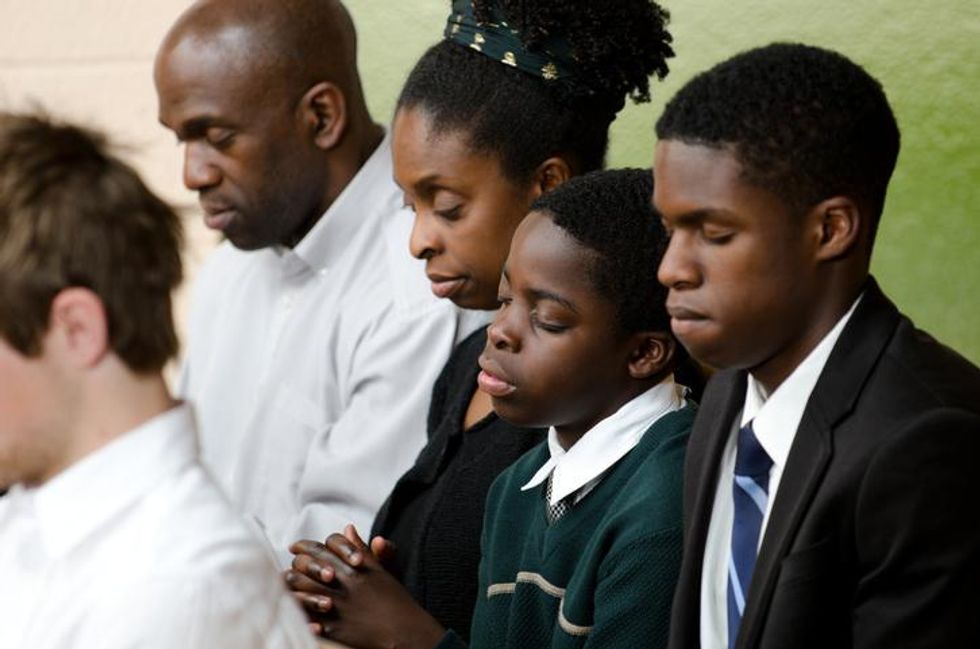
Black Us citizens are much more spiritual than the all round U.S. populace, with 59% describing faith as “very significant to them” when compared to 40% all round. In that context, mental wellbeing problems can be witnessed as a individual or spiritual weak spot, and Bryant said Black people working with psychological wellness challenges may well be told that past generations survived substantially even worse during slavery and segregation. One particular examine implies that 63% of Black Us residents see melancholy as a sign of weakness.
“I consider that’s closer to about 90%,” said Bryant, a member of the North Carolina condition board of the
National Alliance on Mental Disease and founder of Wellness Motion Recovery, Inc. “I communicate at Black church buildings, in particular with older Black persons, and they instructed me they you should not discuss to their pastors simply because of the judgment factor. There are nonetheless pastors who consider it’s a demon that we can just pray it away.”
But
Ruth C. White, a mental health activist and previous school professor in social do the job, who is Black, stated she is viewing a cultural shift in the discussion of mental overall health and therapy. She cites celebs together with Jay-Z, Michelle Obama, Simone Biles and Naomi Osaka who’ve spoken publicly about mental overall health or looking at a therapist, and hashtags like #selfcare, which have exploded throughout Black social media accounts.
In 2011, White
wrote about her own journey with bipolar ailment and psychological wellness procedure. She also detailed the “superwoman” syndrome lots of expert, educated Black ladies might facial area as they operate to juggle demanding careers, loved ones fears, parenthood and fiscal stressors, and how all those anticipations can exacerbate mental health and fitness problems.
“I assume we’re substantially even further along than we ended up 10 several years ago,” White explained. “Back then, I even requested myself, ‘Do I definitely want to converse about this? Do I want to be identified as the mad professor girl?’ I understood that if I’m going to advocate for mental wellness, I have to be open with my personal mental health journey.”
But stigma nonetheless exists all over mental health diagnoses.
“Going to a therapist is good, but a ton of folks really do not like the thought of staying frustrated, getting bipolar ailment, remaining schizophrenic or obtaining obsessive compulsive ailment,” she reported. “Those still have stigma attached simply because now you’re acquiring into the realm of ‘being ill.’”
Increasing their voices
Regardless of suffering as a result of despair and suicidal ideas in the course of her childhood, it took a suicide endeavor and hospitalization for Lindsay Anderson, 37, to absolutely grasp something was wrong. She been given diagnoses of generalized stress and anxiety and PTSD soon after remaining hospitalized in 2005, but didn’t have her bipolar disorder identified till 2017, leaving her without the suitable treatment routine for 12 a long time.
When Anderson created a lifestyle-centered YouTube channel, she included a weekly “Transparency Thursday” movie the place she talked about her own mental overall health. The reaction was overpowering, in particular from Black females, and she shifted the channel’s concentrate completely to psychological wellness. Currently, she talks about the influence of psychological disease on the Black group, together with her possess journey, on her
Consciously Coping platform.
“The visibility of people who control a mental wellness dysfunction is crucial in all communities, but undoubtedly in ours,” Anderson stated. “Many young people today in the Black neighborhood are staying exposed to psychological well being wellness conversations. It is giving them a feeling of possession around their wellbeing, and they’re witnessing the added benefits of communicating how they come to feel.”
But Anderson agrees with White’s sentiment that there’s significantly a lot more soreness talking about an true affliction, specially if it goes outside of what Anderson calls the “nice disorders” of anxiousness or melancholy. And, like Bryant, Anderson had friends and household refuse to go over her hospitalization, selecting to “act like it never happened.”
That is why she desires to fight the stigma by becoming open about her problems, even if it makes other people awkward.
“When I speak on a panel or podcast, I usually start out with ‘My purpose is not to make you truly feel snug,’” Anderson claimed. “I say this simply because if I problem your perceptions, you can reassess your possess stigma. I would not automatically say stigma is lessening amid youthful people today, but the voices of the psychological overall health neighborhood and mental health issues advocacy are getting louder.”
Assets
The Black Woman Health practitioner
National Alliance on Mental Ailment (NAMI)
National Suicide Prevention Lifeline
From Your Web page Articles
Relevant Content articles All-around the Internet